


A gas turbine or gas engine does not care what the pipeline delivers. It cares about what arrives at its fuel inlet: how clean the gas is, whether liquid is present, how far it sits above its dew point, how steady its pressure is and whether its heating value stays in the allowed band. The manufacturer writes these fuel gas requirements into a fuel gas specification; a fuel gas conditioning skid closes the gap between supply conditions and that document.
For the equipment itself, see our fuel gas conditioning and metering skids for gas turbines and engines page. This article covers the step before design: reading the specification, mapping each requirement to a skid function, and assembling the data a supplier needs to quote. Limits differ by manufacturer, model and combustion system, so for every value, refer to your turbine or engine OEM's fuel specification.
What a fuel gas specification typically covers
Cleanliness and particulates
Solid particles erode fuel control valves and nozzles and can plug small passages. The specification limits particle size and/or concentration at the fuel inlet, which defines the final filtration stage, not only the first.
Liquids
Most specifications require gas free of liquid water and hydrocarbons at the inlet, because liquids cause combustion instability, local over-temperature and hardware damage. Removing free liquid is half the job; the other half is ensuring none forms downstream.
Superheat and temperature
The specification sets a minimum margin above the hydrocarbon and water dew points at a defined point, often the gas control valve or fuel inlet. Joule-Thomson cooling across pressure reduction and piping heat loss mean the margin must be verified there, not only at the skid outlet. Dew points must be evaluated at the pressure at that point, not at supply pressure. Some specifications also set a maximum or target fuel temperature.
Supply pressure and stability
Besides the allowed pressure range, there is a limit on how fast and how far pressure may fluctuate during load changes, load rejection and trips. Too low a pressure calls for a fuel gas compressor, normally a separate package.
Heating value and Wobbe index
Combustion systems, especially low-emission ones, are tuned for a heating value and Wobbe index range and may limit their rate of change. Both are calculated from composition with a standard method such as ISO 6976. Some OEMs use a temperature-corrected (modified) Wobbe index, which links fuel temperature control to heating value. Multiple gas sources make this item a priority. If hydrogen blending is planned, raise it early and confirm OEM limits; it also affects material, meter and analyzer selection.
Contaminants
Sulfur compounds and, in many specifications, trace metals such as sodium and potassium are limited because of hot corrosion and deposits. Some cannot be removed on a skid and must be controlled at the source or monitored.
Mapping specification parameters to skid functions
Particulates — Why it matters: Erosion of fuel valves and nozzles, plugging; Skid component that handles it: Scrubber or filter-separator upstream; fine final filter close to the consumer interface
Free liquids (water, hydrocarbons) — Why it matters: Combustion instability, over-temperature, hardware damage; Skid component that handles it: Scrubber / filter-separator with level-controlled liquid drain
Aerosols and fine droplets — Why it matters: Droplets vaporize in the heater and can condense again downstream; Skid component that handles it: Coalescing filter upstream of the heater
Superheat above dew point — Why it matters: Prevents liquid forming after pressure reduction and in piping; Skid component that handles it: Preheater before pressure reduction; performance or trim heater with temperature control
Supply pressure range — Why it matters: Below-range pressure starves the unit; above-range pressure must be reduced safely; Skid component that handles it: Pressure regulator or control valve; compressor interface if supply is too low
Pressure stability — Why it matters: Load rejection and trips cause sudden flow changes; Skid component that handles it: Regulating run sized for response; monitor regulator, slam-shut and relief with staggered set points
Heating value / Wobbe index — Why it matters: Combustion tuning, emissions, interchangeability; Skid component that handles it: Online gas analysis (process gas chromatograph) feeding the control system
Sulfur and other contaminants — Why it matters: Corrosion and deposits; Skid component that handles it: Analyzer or sampling for monitoring; source control where removal is not feasible
Consumption data — Why it matters: Heat rate and efficiency monitoring; Skid component that handles it: Meter run with pressure and temperature measurement and flow computer
Safe isolation — Why it matters: Fire, gas detection or unit trip; Skid component that handles it: ESD valve(s) and interlocks with the plant safety system
Already have an OEM fuel gas specification? Send it with your supply gas data and we will check each requirement against your conditions before design starts.
How the skid sequence follows from the table
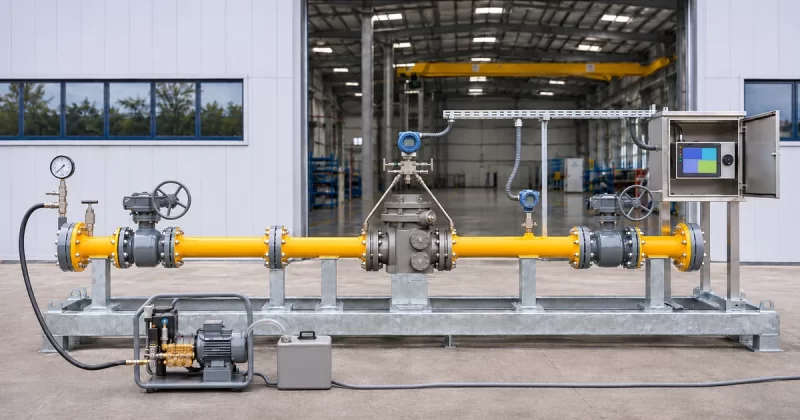
Read top to bottom, the table gives the usual order: isolation and ESD, liquid and solids removal, coalescing filtration, preheating, protected pressure control, performance or trim heating where required, metering, final filtration and the consumer interface. Details are on separate pages: filter types on gas filtration and metering skids, heater options and Joule-Thomson cooling on gas heating, pressure regulating and metering skids, and composition, calorific value and dew point measurement on natural gas quality measurement and analysis systems.
Pressure control and overpressure protection
Here gas turbine duty differs most from a network station. The run must hold pressure through fast flow changes, and the protection chain (active regulator, monitor, slam-shut, relief) must be set so a trip causes neither a nuisance shutdown nor overpressure. EN 334 (regulators) and EN 14382 (safety shut-off devices) are useful general references; the arrangement logic is on our gas pressure regulating skids page.
Metering and analysis
Fuel gas metering usually serves performance and allocation; billing is normally done at a separate custody transfer station at the plant boundary. Heat rate needs both quantity and calorific value, so decide early whether calorific value comes from an online analyzer or supplier data.
TLY Energy's fabrication scope
TLY Energy fabricates the skid frame, process piping, filter vessels, heaters and meter runs in its own workshop in Türkiye; welding is carried out under an EN ISO 3834-2 certified quality system, and the company operates an ISO 9001:2015 quality management system accredited through TÜRKAK. Flow meters, transmitters, regulators, control valves and analyzers are selected for the application, procured from their manufacturers and integrated on the skid.
RFQ checklist: data to send for a fuel gas conditioning skid
Consumer type, number of units, OEM fuel gas specification (document and revision)
Point where the specification must be met (e.g. gas control valve, fuel inlet flange)
Supply gas composition, water and hydrocarbon dew points, any history of liquid or compressor oil carryover
Minimum, normal and maximum supply pressure, gauge or absolute
Required consumer pressure and allowed fluctuation during load changes and trips
Flow per unit at start-up, minimum and full load, with reference conditions
Supply gas and site ambient temperature ranges
Available heating source (electric, hot water, waste heat) and auxiliary system limits
Metering purpose (performance, allocation, billing), per-unit or common
Analysis needs: calorific value, Wobbe index, dew point, sulfur
Redundancy (e.g. duplicate filter or regulating runs)
ESD, interlock and signal interface with turbine and plant control systems
Hazardous area classification, design codes, required documents and tests
Why each value matters is explained for pressure reduction stations in our article on what process data an RMS/PRMS station quotation needs. For fuel gas, the OEM specification is the extra input that overrides network conditions.
FAQ
Is a filtration skid enough for a gas turbine?
Usually not. The fuel specification also requires superheat above dew point, pressure stability and often heating value monitoring, which are designed together with filtration.
Where is the superheat margin measured?
At the point the OEM specification defines, typically the gas control valve or fuel inlet. Heater design must include pressure reduction and piping losses up to that point.
Do I need a gas chromatograph?
Consider online analysis if heating value or Wobbe index may vary, gas comes from several sources, or hydrocarbon dew point is close to operating temperature.
Can sodium or potassium be removed on the skid?
Partly. They usually travel with entrained water, salt or droplets, so efficient liquid and particle removal is the skid's main defence. The skid cannot guarantee a trace-metal limit; that is controlled at source and verified by sampling.
What if supply pressure is below the turbine requirement?
A fuel gas compressor, usually a separate package, is needed. Define its position relative to the conditioning steps and how discharge temperature and oil carryover are handled.
Send us your fuel gas specification
Have an OEM fuel gas specification and supply gas data? Send them through our contact page; we will review the specification against your supply conditions and prepare a fuel gas conditioning and metering skid proposal.